How Many Calories Should I Eat a Day?
Most women need 1,600–2,400 calories a day and most men 2,000–3,000. Find your number with a simple formula, a chart by age and easy recipes.

How Many Calories Should I Eat a Day?
Most adult women need about 1,600–2,400 calories and most men about 2,000–3,000, depending on age, size and how active they are. Below you will find a chart by age, a simple formula for your own number, how to adjust it to lose or gain weight, and recipes that make the numbers easy to hit.
Short answer: an average woman needs about 2,000 calories a day and an average man about 2,500. Your own number can be a few hundred higher or lower. Use the chart or the formula below to find it.
How many calories do you need a day? (chart)
These estimates keep your weight stable. They come from the US Dietary Guidelines and assume a healthy weight and average height.
| Age | Women, not active | Women, active | Men, not active | Men, active |
|---|---|---|---|---|
| 19–30 | 1,800–2,000 | 2,400 | 2,400–2,600 | 3,000 |
| 31–50 | 1,800 | 2,200 | 2,200–2,400 | 2,800–3,000 |
| 51+ | 1,600 | 2,000–2,200 | 2,000–2,200 | 2,400–2,800 |
"Not active" means only the light movement of daily life. "Active" means daily life plus walking more than 3 miles (about 5 km) a day at a brisk pace, or the same effort in other exercise. If you are in between, pick a number in the middle.
Pregnancy and breastfeeding raise your needs, usually by a few hundred calories a day from the second trimester. Ask your doctor or midwife for your number.
How to calculate your daily calories
The chart is a quick guide. For a more personal number, use the Mifflin–St Jeor formula, which is the one most dietitians use. It takes two steps.
Step 1: find your BMR
Your BMR (basal metabolic rate) is the energy your body burns at complete rest.
- Women: 10 × weight (kg) + 6.25 × height (cm) − 5 × age − 161
- Men: 10 × weight (kg) + 6.25 × height (cm) − 5 × age + 5
If you use pounds and inches: weight in kg = pounds ÷ 2.2, height in cm = inches × 2.54.
Step 2: multiply by your activity level
| How active you are | Multiply BMR by |
|---|---|
| Mostly sitting, little exercise | 1.2 |
| Light exercise 1–3 days a week | 1.375 |
| Moderate exercise 3–5 days a week | 1.55 |
| Hard exercise 6–7 days a week | 1.725 |
| Physical job plus daily training | 1.9 |
The result is your maintenance calories: the amount that keeps your weight about the same.
Examples:
- Woman, 30 years, 65 kg, 165 cm, light exercise: BMR = 650 + 1,031 − 150 − 161 = 1,370. Then 1,370 × 1.375 = about 1,900 calories a day.
- Man, 35 years, 80 kg, 180 cm, moderate exercise: BMR = 800 + 1,125 − 175 + 5 = 1,755. Then 1,755 × 1.55 = about 2,700 calories a day.
Any formula is an estimate and can be off by about 10%. Eat at your number for 2–3 weeks and watch your weight. If it goes up, eat a little less; if it drops, eat a little more.

What changes how many calories you burn
- Body size: a larger body burns more energy, even at rest.
- Muscle: muscle burns more than fat, which is one reason strength training helps.
- Age: needs drop slowly with age, mostly because people move less and lose muscle.
- Sex: men usually need more because they tend to be larger and carry more muscle.
- Daily movement: walking, standing and chores can add hundreds of calories a day, often more than a workout.
How many calories to lose weight
To lose weight, eat less than your maintenance calories. This gap is called a calorie deficit. A deficit of about 500 calories a day usually leads to about 0.5 kg (1 lb) of weight loss a week at first.
Weight loss slows over time, because a smaller body burns less. The free NIH Body Weight Planner shows this and tells you how many calories you need to reach a goal weight by a set date.
A few rules make a deficit easier to keep:
- Do not go too low. Most experts advise women not to eat less than about 1,200 calories a day, and men not less than about 1,500, unless a doctor supervises.
- Keep protein high. About 1.2–1.6 g of protein per kg of body weight helps you stay full and keep muscle. See how much protein you need a day.
- Fill half your plate with vegetables. They add volume for very few calories.
How many calories to gain weight or build muscle
To gain weight, eat more than your maintenance calories. A surplus of about 250–500 calories a day is enough for most people. Pair it with strength training 2–3 times a week so most of the gain is muscle, not fat.
Protein matters here too: aim for about 1.6–2.0 g per kg of body weight. Our high-protein chicken bowl is an easy post-workout meal.
Where calories come from
All calories come from four sources in food and drink.
| Nutrient | Calories per gram |
|---|---|
| Fat | 9 |
| Alcohol | 7 |
| Protein | 4 |
| Carbohydrates | 4 |
Fat has more than twice the calories of protein or carbs, so oils, nuts and butter add up fast. That does not make them bad; healthy fats are part of a good diet. It just means portions matter.
Protein and fiber keep you full the longest for the calories. That is why meals built around lean protein, vegetables and whole grains make it easier to eat the right amount without feeling hungry.
How to split your calories across meals
There is no single best split. For a 2,000-calorie day, a simple pattern looks like this:
- Breakfast: 400–500 calories
- Lunch: 500–600 calories
- Dinner: 600–700 calories
- One or two snacks: 200–300 calories in total
If you are rarely hungry in the morning, move some calories to lunch. What matters most is your total for the day.
A 2,000-calorie day: sample menu
This day gives about 2,000 calories and more than 120 g of protein. Swap in any recipes you like.
| Meal | Recipe | Calories (approx.) |
|---|---|---|
| Breakfast | Overnight Oats with chia seeds | 248 |
| Lunch | High-protein chicken bowl | 550 |
| Snack | No-Bake Protein Balls | 152 |
| Dinner | Sesame Beef and Broccoli | 852 |
| Snack | Pecan Chickpea Blondies | 276 |
| Total | ≈ 2078 |
Low-calorie foods that keep you full
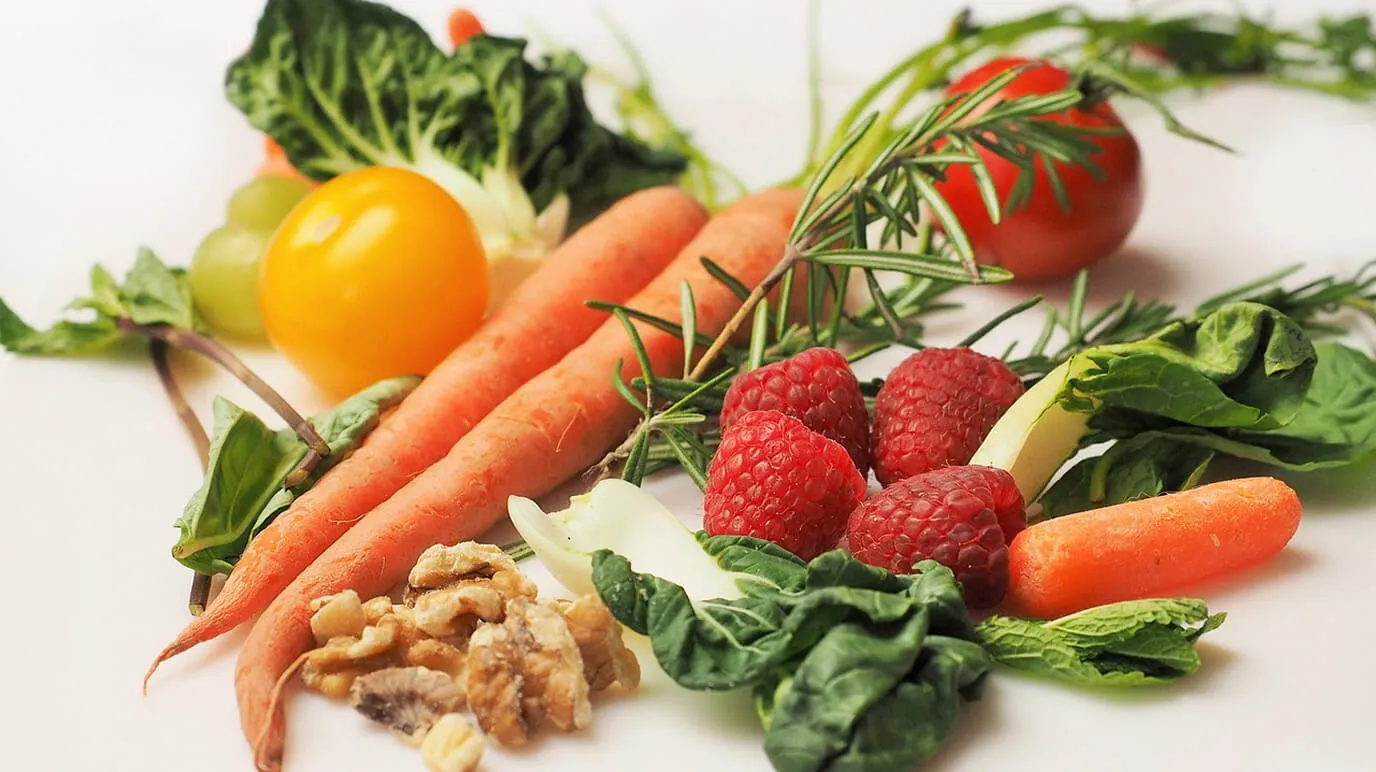
Some foods give you a lot to eat for few calories; others pack many calories into a small portion. Values are approximate.
| Food | Portion | Calories (approx.) |
|---|---|---|
| Cucumber | 100 g | 15 |
| Strawberries | 100 g | 32 |
| Broccoli, cooked | 100 g | 35 |
| Egg | 1 large | 72 |
| Potato, boiled | 100 g | 87 |
| Apple | 1 medium | 95 |
| Greek yogurt, nonfat | 170 g (1 cup) | 100 |
| Lentils, cooked | 100 g | 116 |
| Olive oil | 1 tbsp | 119 |
| Oatmeal, cooked with water | 1 cup (234 g) | 166 |
| Chicken breast, cooked | 100 g | 165 |
| Almonds | 30 g | 170 |
| Salmon, cooked | 100 g | 206 |
One tablespoon of olive oil has about as many calories as a whole bowl of strawberries and broccoli. Measure oils and nuts; eat vegetables and fruit freely.
Do you need to count calories?
No. Counting helps some people learn portions, but it is not required. A simple plate method works for most meals: half vegetables, a quarter protein and a quarter whole grains or starchy foods, plus a little healthy fat.
If you do count, use an app for a few weeks to learn what your usual meals contain, then switch to eyeballing portions.
When to ask a professional
Talk to a doctor or registered dietitian before changing your calories if you are pregnant or breastfeeding, have diabetes, kidney or heart disease, take medicines that affect appetite or weight, or have a history of eating disorders.
FAQ
Is 1,200 calories a day enough?
For most adults, no. It is about the lowest most experts advise for women without medical supervision, and too low for most men. Very low intakes make it hard to get enough protein, fiber, vitamins and minerals.
How many calories should I eat to lose 1 kg a week?
Losing 1 kg (about 2 lb) a week needs a deficit of roughly 1,000 calories a day. That is too much for most people. A 500-calorie deficit and about 0.5 kg a week is easier to keep up.
How many calories do I burn a day doing nothing?
That is your BMR. For most adults it is about 1,200–1,800 calories a day. Use the formula above to work out yours.
Should I eat back the calories I burn exercising?
Partly. Fitness trackers often overestimate calories burned, so eating back about half is a safer rule. Watch your weight over a few weeks and adjust.
Are all calories the same?
For weight, a calorie is a calorie. For hunger and health, the source matters: 300 calories of chicken and vegetables keep you fuller and give more nutrients than 300 calories of candy.
How many calories are in a gram of fat?
About 9. Protein and carbohydrates have about 4 per gram, and alcohol about 7.
Comments